

Article by

Topics

One platform to manage the entire IT device lifecycle
GET STARTEDEffective onboarding is critical for employee success on many levels.
Not only does a good onboarding program hasten ramp time and build confidence in a new employee, but it also heavily impacts employee motivation and long-term retention.
In a recent survey, we compiled a list of fascinating employee onboarding statistics to create a comprehensive picture of the current state of onboarding practices for new hires.
Here are some of our key takeaways.
- Nearly a third of employees rated their onboarding experience as average or below average
- Nearly half of formal onboarding programs lack adequate structure
- Many new employees were left to figure things out on their own
- Nearly a third of new employees were missing equipment on their first day
- 16% of employees seriously considered quitting within the first month simply because of a poor onboarding process
Now let’s dive into our employee onboarding statistics in full detail.
Most Onboarding Falls Short
So how successful is the average onboarding program in 2026? Honestly, it’s a little underwhelming.
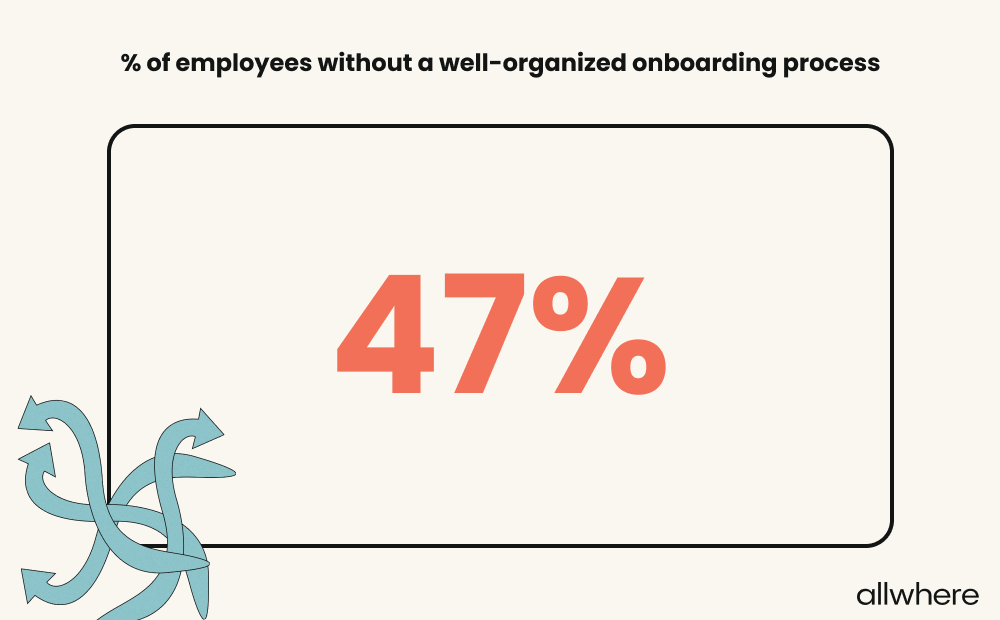
Our survey found that just over half (53%) of organizations have a full-on structured onboarding process for employees during their first days and weeks. Put another way, 47% of employees do not have a well-organized onboarding process.
However, 37.5% of employees report that there’s only “somewhat” of a structured onboarding process, but there’s “little guidance, and it’s loosely organized.”
And the remaining 9.5% of workers say that there’s no structured onboarding process and they were mostly left to themselves to figure things out.
These numbers show that nearly half of today’s companies lack a strong onboarding process and that a structured onboarding program is very much needed for many companies, especially those with a high remote employee count.
Further, only 69% of employees rated their IT onboarding experience as excellent or good, while 25.5% rated it as average, 4.5% rated it as poor, and 1% rated it as very poor.
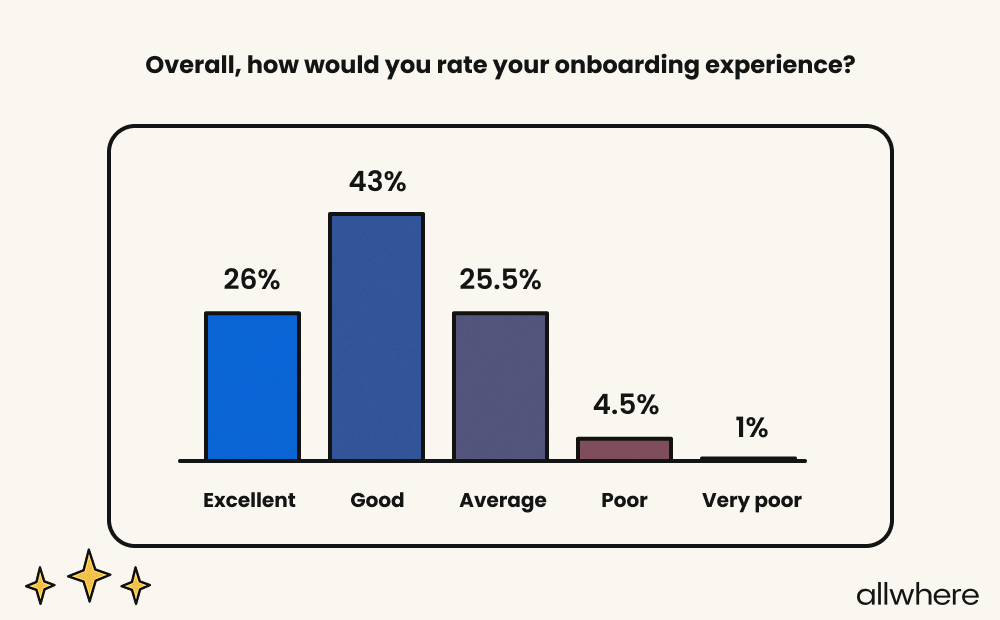
This data shows that around 3 out of every 10 organizations could create a more effective onboarding process, and formal onboarding training is a great place to start.
New Hires Are Left to Figure It Out Alone
The entire purpose of onboarding programs is to show employees the ropes and help them get their bearings when starting a new role.
This doesn’t necessarily mean hand-holding with a full-on onboarding buddy, but a successful onboarding program should guide new workers as they transition into their jobs.
But what’s interesting is that far more employees than you may think aren’t given proper guidance during the onboarding process.
More specifically, we asked in our survey, “In your first week, how much were you left to figure out on your own?”
Here were the results.
- 7% of employees said almost everything
- 31% said a lot
- 34.5% said some
- 17% said a little
- 10.5% said almost nothing
By this data, a whopping 38% of employees were essentially left on their own during their first week on the job, and an additional 34.5% had minimal direction.
Conversely, only 27.5% received comprehensive onboarding, something that can create a poor onboarding experience and compromise long-term onboarding success. This is especially true when it comes to virtual onboarding for remote employees.
Bad Onboarding Drives New Hires Toward the Exit
Premature turnover is incredibly toxic to an organization’s bottom line and can dramatically raise your overall onboarding cost.
For perspective, “It costs around $4,425 to hire a new employee, much higher than the previous average. Additionally, it takes on average 36 days to fill a given vacancy or opening within a firm.”
Not to mention, it often hurts employee engagement and productivity, increases the workload for other employees, and lowers morale.
And while many factors can contribute to premature employee turnover, poor onboarding is a major one.
To quantify, our survey found that 16% of employees seriously considered quitting in their first month due to a bad onboarding experience. And those who rated their experience as average or worse were 2.5X more likely to have considered it (27% vs 11%).
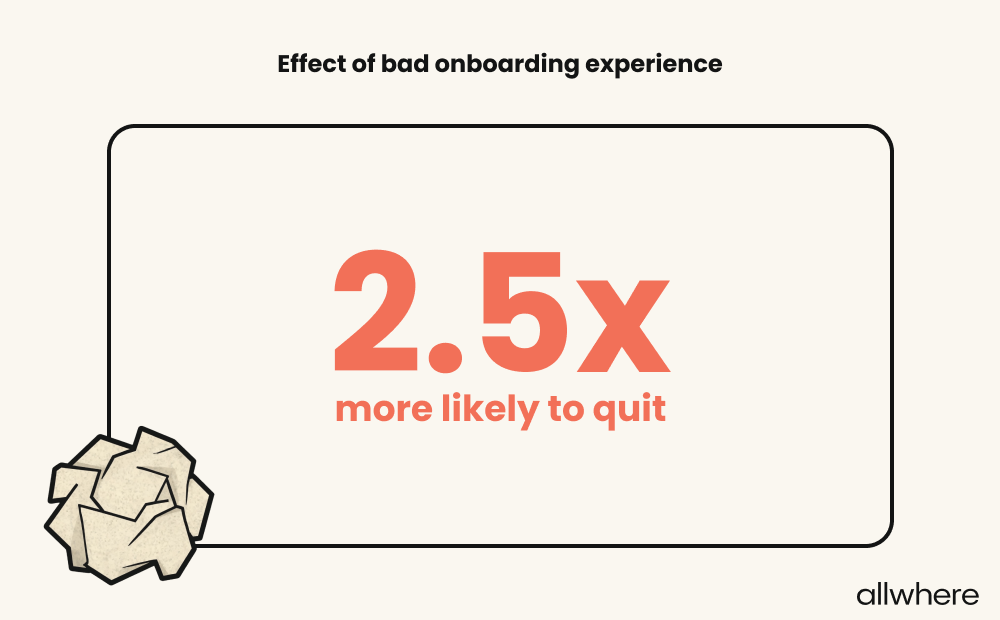
While this doesn’t necessarily mean that your company is going to implode because of a few poor employee onboarding experiences, consistently bad onboarding can certainly be harmful to your employee retention rate and can increase overall onboarding costs.
This is yet another reason why it’s so important to have a structured employee onboarding process to ensure a positive onboarding experience.
First Impressions Form Within Days
As the old adage goes, you only get one chance to make a first impression.
Good or bad, employee first impressions are usually lasting impressions and can affect performance, productivity, and retention.
But just how long does it take for employees to form a lasting impression of a company?
Here are some survey statistics.
- Lasting impressions happen within the first day for 5.5% of employees
- Within the first week for 28.5%
- Within the first month for 35%
- Within three months for 19%
- Longer than three months for 12%
The bottom line here is that lasting impressions are formed within seven days for 34% of employees and within the first month for 35%.
With so much riding on employee satisfaction with onboarding programs, it’s vital that your employee training hits the right notes and creates a strong impression.
It’s also worth noting that “69% of employees who have an exceptional onboarding experience are likely to stick around for at least three years.”
Over Half of Employees Can’t Fully Work on Day One
Needless to say, proper preparation is an integral part of good onboarding practices.
This allows new hires to jump right in and not have their performance diminished by struggling to log in or being disrupted by not having proper system access.
But a major onboarding challenge we found from our survey statistics was that the majority of employees aren’t set up to fully work on their first day.
When asked, “On your first day, were your accounts, software, and system access fully set up and working?” 45% said “yes, they were fully set up,” 48% said “partly — some access was missing or delayed,” and 7% said, “no — little or nothing was ready.”
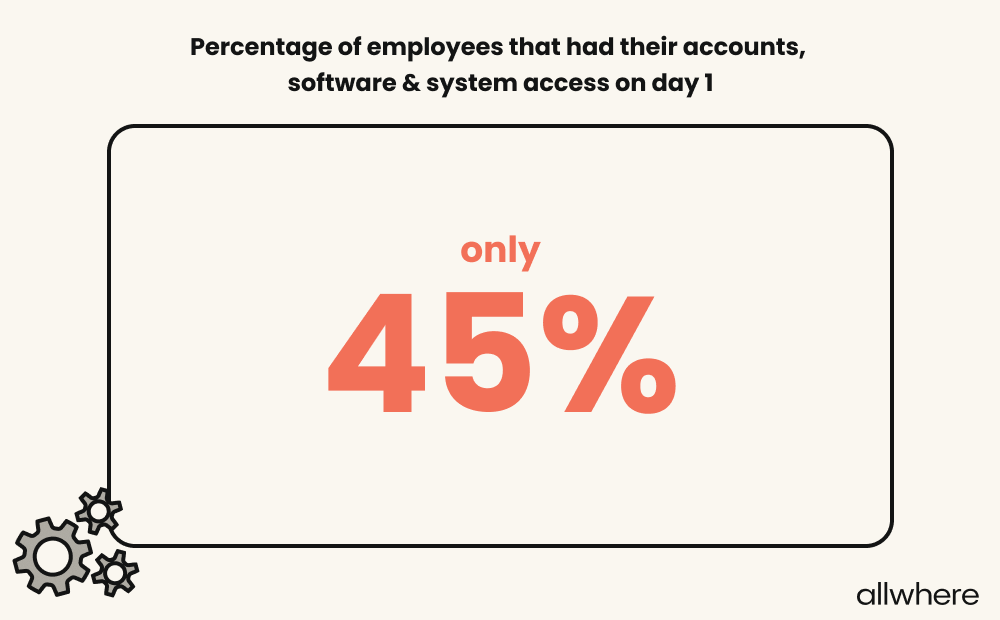
In other words, 55% of employees don’t have the necessary tools ready to begin working on day one.
When you consider that employees who have all of the equipment ready on day one are more than four times as likely to rate their onboarding experience as excellent, you can see the importance of having employees fully set up.
The Equipment Gap is Real and Measurable
Piggybacking on the previous section, our survey statistics identified some additional information about employees being unable to fully work right off the bat.
More specifically, this pertains to having all of the equipment and technology needed to perform their job, such as a laptop, phone, and mobile device.
When asked whether or not new hires had everything necessary on their first day, 68.5% said yes, everything was ready. However, 29.5% of new hires said some things were missing, and 2% said they had almost nothing.
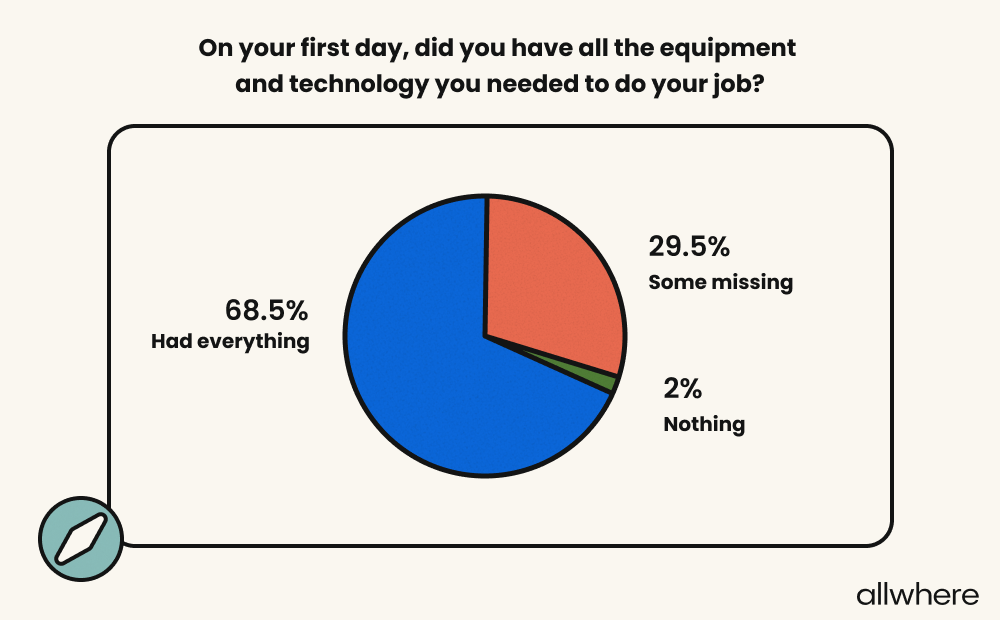
While these numbers aren’t over the top, as only 2% of new hires said they had almost nothing, it shows that nearly a third of employees were missing at least something when completing onboarding tasks.
If your company falls into this trap, it can greatly reduce your team’s collective performance, create unnecessary friction, and hurt the overall employee experience.
And if left unchecked long-term, this could even factor into higher turnover, which can unleash a host of other unsavory consequences.
Equipment Readiness Separates Great Onboarding From Forgettable
One of the biggest takeaways from our survey statistics is that there’s an undeniable correlation between new hires being equipment-ready and having a great onboarding experience, as well as being poised for success.
Consider this.
31.5% of new hires said they were missing something on their first day, and 31% reported having an average or below-average onboarding experience. That’s almost the exact same number.
This shows just how crucial it is to ensure that 1) each new employee has the right equipment on their first day and 2) everything is properly configured with system access so they’re not fumbling around trying to use the tools necessary to perform their job.
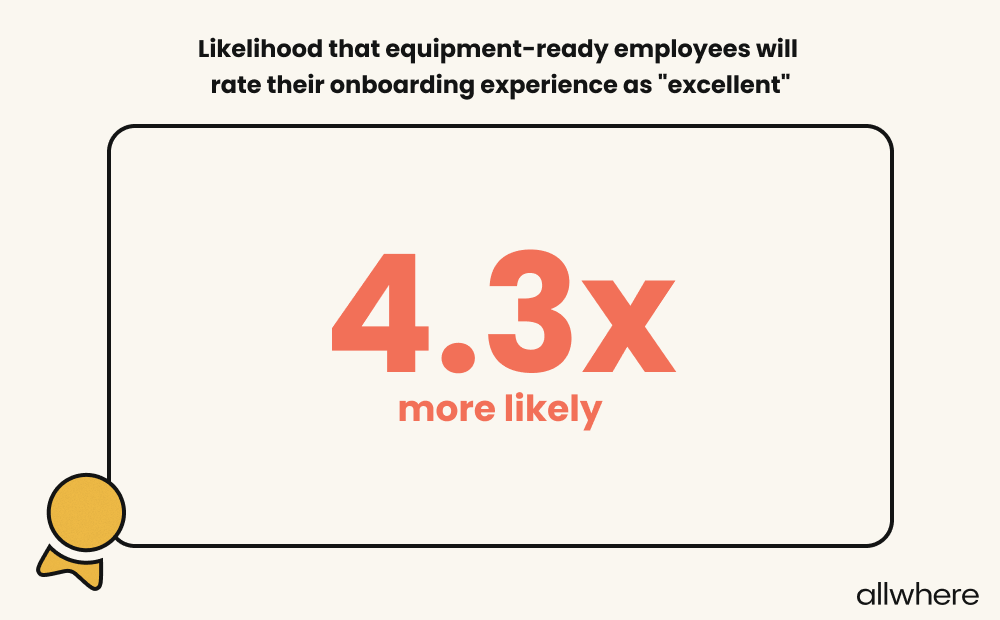
Once again, employees who had all their equipment ready on day one were 4.3x more likely to rate their onboarding experience as “excellent” (34% vs 8%).
So if this has historically been an area where you’ve skimped with the intention of rolling full equipment out later on, it’s an area we suggest addressing for more effective onboarding.
Missing Hardware and Access Slow New Hires Down
As we mentioned earlier, 31.5% of workers were missing some type of equipment and technology, and 55% didn’t have all of their accounts, software, or system access fully set up on their first day.
Because of this, our survey found that it took a while for many employees to feel fully productive in their role. More specifically, we found that only 10% felt fully productive in their first week.
Further:
- It took 37% of employees 2 - 4 weeks to feel fully productive
- It took 33% of employees 1 - 3 months
- It took 14% of employees 4 - 6 months
- It took 6% of employees more than 6 months
The bottom line here is that those who started without the equipment they need took a month or more to reach full productivity far more often (67% vs 47%). And the same pattern is true for those missing system access (60% vs 44%).
Based on these onboarding trends, it’s clear that it’s worth the effort to ensure new employees are fully decked out with the correct equipment and access from day one — something that can lead to considerably better onboarding.
If this is an area you need help with, you may want to consider IT procurement services and employee onboarding through a third-party like allwhere, as this handles all of the logistics for a stress-free experience.
Methodology
The goal of our survey was to generate concrete statistics to better understand onboarding practices among modern companies, as well as what the typical onboarding experience was like for new employees.
To accomplish this, we surveyed 200 respondents, all of whom worked at a desk and used a computer most of the day.
Respondents were asked 10 questions, such as whether or not their employer had a structured onboarding process, what their on boarding experience was like, and if IT equipment and system access were fully available on day one.
The goal was to help modern organizations understand things from an employee’s point of view and create the best employee onboarding experiences possible. In turn, they can at the very least, establish good onboarding, if not great onboarding.
