

Article by

Topics

One platform to manage the entire IT device lifecycle
GET STARTEDWith many employees using their own devices for work, Bring Your Own Device (BYOD) adoption is a hot topic for many companies.
To gain perspective on BYOD trends and patterns, we conducted a survey where we discovered how many employees are using their own devices for work purposes, what they do with their devices, what they access, and more.
Popularly cited research claims that 80% of employees use a personal device in some capacity, indicating that, at least on paper, BYOD usage is the norm for four out of five companies.
But as we’ll discuss, BYOD employee stats like these can be misleading.
With that said, let’s take a deep dive into some 2026 BYOD statistics to get a better sense of the details.
Key BYOD Statistics (2026)
- Only 11% of workers actually bring their own personal device (computer or laptop) for work - not 80%.
- 27% of workers regularly use their smartphone for work, and an additional 27% use it occasionally.
- The top three uses for personal smartphone use for work include: checking email, messaging/chat, and two-factor authentication.
- Only 39% of employees said that their employer requires them to install cybersecurity or management software on the personal phones they use for work.
- Only 31% of employees said that their company has an official BYOD policy.
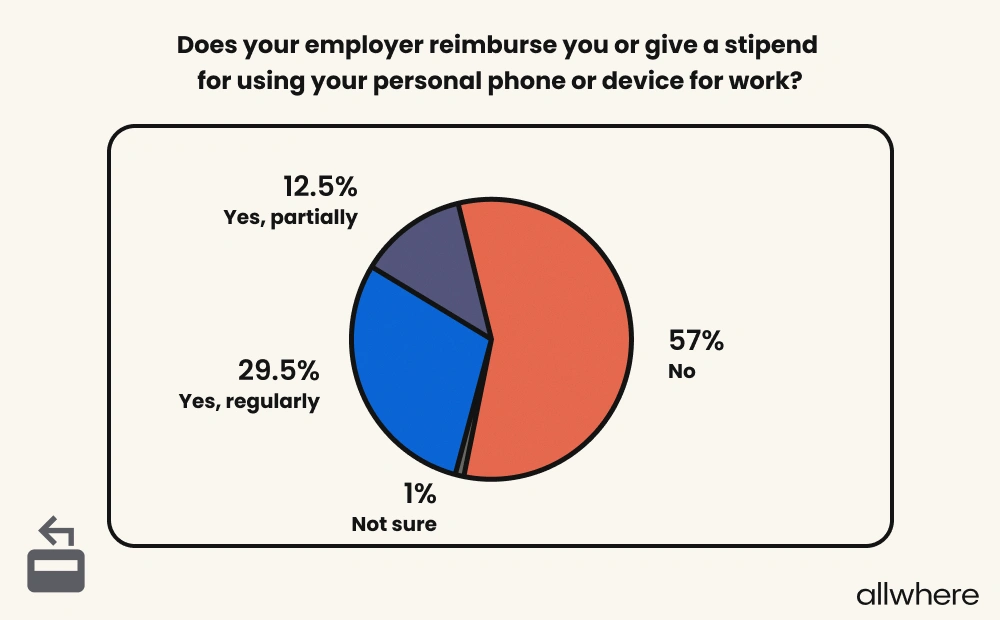
- 57% of employers provide no reimbursement or stipend for their employees’ use of a personal device at work.
Only 11% Bring Their Own Device
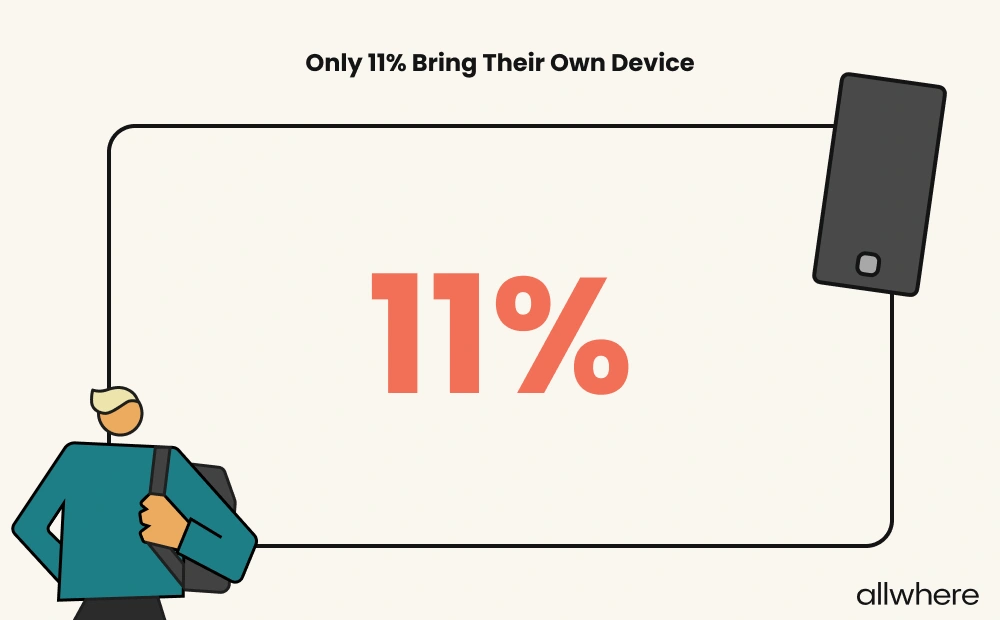
The general narrative these days is that “everyone brings their own device” to work — or at least the vast majority do.
We just mentioned one stat that said 80% of workers use a personal device on some level. And there’s a similar stat that says 83% of companies have implemented some form of BYOD policy.
This type of data implies that the majority of the workforce is implementing wide-scale BYOD adoption.
But in reality, this isn’t the case, and only a small number of employees actually have to use their own device for workplace productivity.
More specifically, our survey found that just 11% of employees aren’t given their own device (laptop or desktop) for workplace productivity.
Conversely, general employee BYOD statistics found that 89% of organizations in 2026 provided their employees with a company-owned device.
The point here is that simply having a BYOD policy in place doesn’t mean that everyone is using their own personal device for day-to-day work tasks.
In fact, this directly refutes the “everyone brings their own device” implication that the 83% stat leans on.
The bottom line is that nearly nine in 10 workers are handed a company machine. Further, of the employees that use a personal device, only 61.8% use it regularly as a primary device.
How Much Employees Actually Rely on Personal Devices
Now let’s go a little deeper and take a look at just how reliant employees are on three specific types of devices: personal smartphones, personal laptops/desktops, and personal tablets.
We surveyed computer-based employees and asked them how much they used their phones, home computers, and personal tablets for work.
Based on these corporate network findings, we can say that most employees don’t use a tablet for work purposes (less than 4 out of 10 do), and far more employees use a personal smartphone or laptop/desktop.
We also found that for personal smartphones, there’s an even mix between occasional and regular use, with 27% using it occasionally and 27% using it regularly.
For a laptop/desktop, more employees use it regularly than occasionally (27% versus 12%).
And for those workers who do use a personal tablet, far more use it regularly than occasionally (21.5% versus 10.5%).
What Employees Actually Do With Work on Their Personal Phones
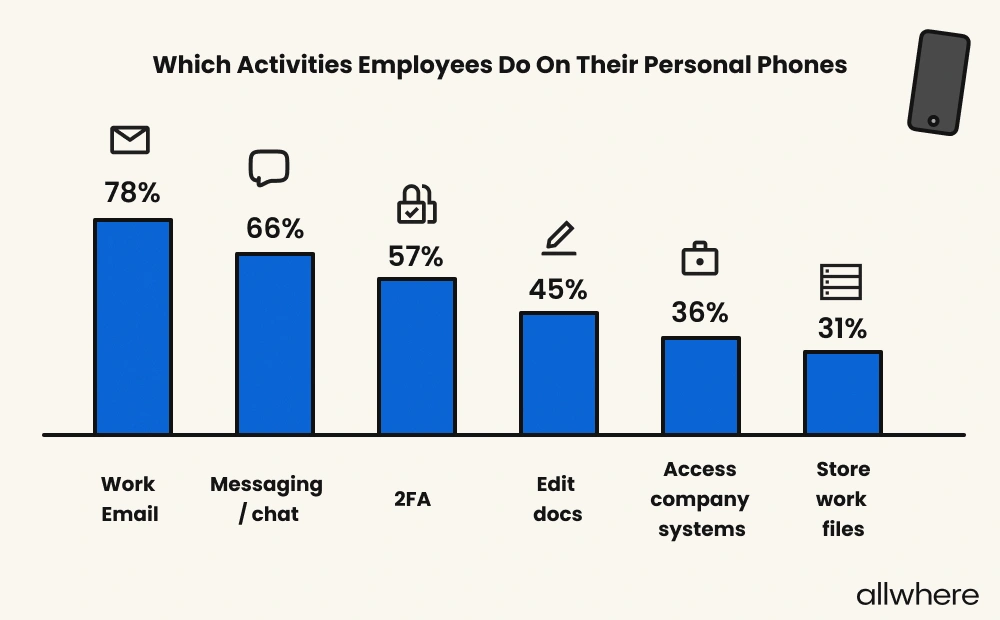
In terms of specific work-related tasks on personal smartphones, here’s what employees reported on our survey in the BYOD environment:
- 78% use work email
- 66% use messaging/chat (Slack, Teams, etc.)
- 57% use two-factor authentication/login approvals
- 45% view or edit work documents
- 36% access company systems (CRM, databases, admin tools)
- 31% store company data work files on their device
From this BYOD practices data, it’s clear that the majority of tasks performed on BYOD smartphones involve work email, with nearly eight out of 10 employees using their devices for this.
And the close runner-up is messaging, with two out of three using their smartphone.
After that, two-factor authentication and viewing or editing work documents are common tasks, while accessing company systems and storing company data work files on a smartphone is done by roughly three out of 10 employees.
A Quarter of Employees Access Core Company Systems From a Personal Phone
Any time a BYOD program is in place, and a large volume of employees are accessing company systems from a personal device like a phone, BYOD security is a major concern.
This is especially true for large enterprises where a data breach with unauthorized access and leaked corporate data or personal data could have a disastrous impact.
As we just mentioned, 36% of today’s workers access company systems like a CRM, databases, and admin tools, while 31% store work files on their device.
But here’s what’s concerning. Only 39% of employees said that their employer requires them to install cybersecurity or management software, such as an MDM on their personal device to use it for work.
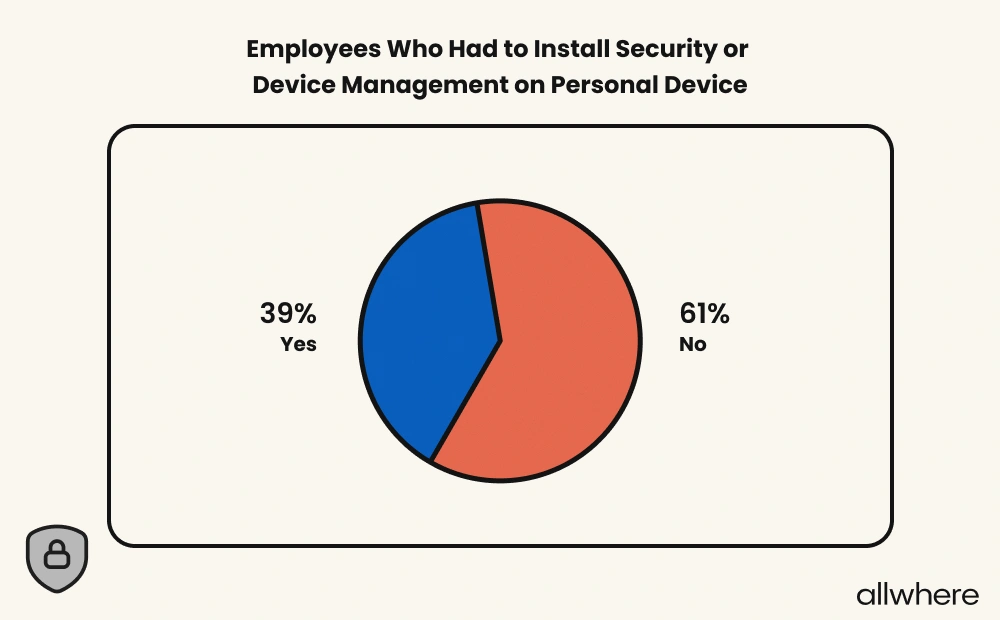
On the other hand, 59.5% of employees said their employer doesn’t require them to install security or management software to protect sensitive data and personal information, while 1.5% were unsure.
This means that many organizations have a BYOD security management gap and could find themselves with serious security concerns if employees lose their smartphone or have it stolen.
For perspective, research has found that 23% of people have lost or misplaced their smartphone at some point, and 5% have had it stolen, for a total of 28%.
When you combine highly sensitive information/corporate data and easy login access with minimal security precautions, this is setting the stage for a huge security risk if devices end up in the wrong hands outside of the intended BYOD user.
So if you have a BYOD-heavy workforce, this shows the extreme importance of taking strong BYOD security precautions to protect sensitive information.
Again, a good starting point for accomplishing this is to install a security solution or management software and have a security policy to protect sensitive data and employee privacy on these highly vulnerable IT assets.
Most Personal-Device Use Isn’t Covered by a Formal BYOD Policy
Earlier, we mentioned that 83% of companies have some type of BYOD policy in place.
But another BYOD trend we thought was interesting was that most personal-device use isn’t part of the policy’s framework.
For instance, when asked, “Which best describes how your employer treats your personal devices (like your phone) for work?” 31% of employees said that there’s an official written policy, while 20.5% said there’s no formal policy.
Another portion of respondents (28%) said that using personal devices for work is required and they’re expected to use their personal device, while 16.5% said they’re not allowed, and personal devices are prohibited for work.
The bottom line here is that if your organization does choose BYOD adoption, it’s important to establish a clear, formal policy in your BYOD plan to eliminate any guesswork as to what employees can and can’t do.
It’s simply part of best practices and should optimize IT onboarding, offboarding, and everything in between.
This is critical for setting boundaries and increasing security measures for sensitive data, as well as creating the best employee onboarding experiences and improving overall employee satisfaction.
Required to Use a Personal Device, but Not Reimbursed
Next, let’s touch on how companies view the use of their employees’ personal devices for work.
- 28% require it
- 31.5% formally allow it and have a written policy in place
- 20.5% tolerate it, but there’s no formal policy
- 16.5% don’t allow it
Additionally, 3.5% of employees who responded to our survey weren’t sure how employers treat using their personal devices for work.
By these numbers, nearly 60% of employers are heavy on personal device usage, with 28% requiring it. Conversely, only a small percentage (16.5%) directly prohibit it for employee productivity.
This brings us to an adjacent question.
If an employee is using their personal phone for work assignments, should an organization be required to pay them for it through a reimbursement or stipend?
Say, for example, an employee is working at home using their Wi-Fi, which uses very little bandwidth. Should an organization compensate the employee for it, and is this considered part of best practices?
In our opinion, most companies don’t necessarily need to give stipends, and most employees don’t expect it. But it’s worth noting that a decent percentage of employees get it anyway.
In fact, our survey found that 29.5% of employees receive regular reimbursement or a stipend and 12.5% receive it partially.
Frequently Asked Questions
How Many Companies Use BYOD?
To recap, 89% of employers provide a company-owned device, while only 11% do not.
As for specific devices, 27% of employees regularly use a personal smartphone and 27% occasionally use it.
21.5% of employees regularly use a personal laptop or desktop, followed by 12% who occasionally use it.
And 21.5% of employees regularly use a personal tablet, while 10.5% occasionally use it.
Also, 28% of companies require their employees to use a personal device, 31.5% formally allow it, 20.5% tolerate it, and 16.5% don’t allow it.
Is BYOD Still A Thing?
The simple answer is yes. BYOD adoption is still done by plenty of companies.
But there’s a misconception as to just how big the BYOD market size truly is, with many stats being misleading as to the sheer volume of organizations that have a BYOD strategy.
In fact, 31% of employees never use a personal smartphone for work, 36% never use a personal laptop or desktop, and 61.5% never use a personal tablet.
What Is An Example of BYOD?
Two of the most common use cases for personal devices are work email, which is done by 78% of employees, and messaging/chat (66%).
This is followed by two-factor cybersecurity authentication/login approvals (56%) and viewing/editing work documents (45%).
Other examples include accessing company systems and storing corporate data work files on a device.
Methodology
This data came from a 2026 BYOD survey involving 200 participants based in the United States. Each participant works full-time in a job that requires them to use a computer for the majority of their workday.
It was conducted by allwhere, a company that supports the entire IT lifecycle end-to-end and specializes in IT procurement services and employee onboarding.
The goal was to gain an objective perspective on the current state of BYOD so modern companies could better understand trends and patterns, optimize their own BYOD program, follow best practices, increase cost savings, and improve cybersecurity.
