
Article by

Topics

One platform to manage the entire IT device lifecycle
GET STARTEDA laptop is the most commonly used IT device for today’s businesses, with 73% of employees relying on them for daily work. Therefore, one of the most important decisions for organizations is to choose between leasing vs buying company laptops.
Here, we’ll lay out the key differences between buying equipment and equipment leasing so you can make an informed decision on what’s best for your company.
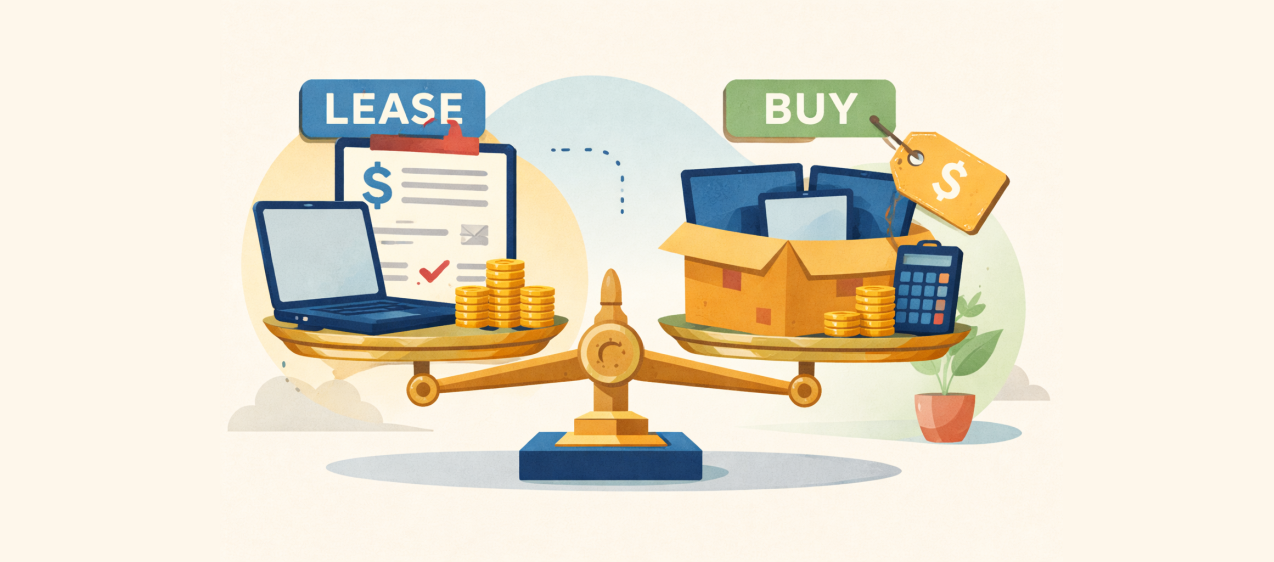
Understanding Laptop Leasing vs Buying for Business
Laptop leasing involves a subscription model where you agree to a contract that typically lasts between two and four years. Once the laptop lease contract is signed, the leasing company will do some or all of the following.
- Provide your organization with the computer equipment outlined in your operating lease agreements
- Configure hardware
- Manage data security
- Manage your service and handle refresh cycles
- Handle warranty coverage
- Take care of device replacement, if necessary, to meet your business need
Once the contract is up, you then have the option of either renewing your leasing agreements. Or, you can end your service and return the business equipment.
You can think of it as a long-term laptop rental where you have a relatively small upfront cost but never actually own the equipment.
On the other hand, when you buy laptops outright, you pay the full price and assume ownership. This comes with a much higher upfront cost when compared with computer leasing, but you have full control of hardware configuration, security, refresh cycles, and so on.
You can also extend your usage past the refresh cycle mandated by a leasing agreement and can potentially resell business laptops once they’ve reached the end of their IT hardware lifecycle within your company.
In turn, purchasing equipment offers far more flexibility for a business owner when compared to a lease term and often creates resale value. However, you do encounter significantly higher initial costs when buying compared to equipment financing.
The Hidden Costs of Leasing Company Laptops
When you look at laptop leasing vs buying strictly in terms of lower upfront cost, it’s clear that leased equipment is more affordable. But if you zoom out and look at the big picture, you’ll see that there are some noticeable drawbacks to be aware of with a computer lease.
And this mainly relates to the hidden costs that business owners aren’t always aware of.
Perhaps the biggest is the lease premiums that are common when leasing hardware. Numbers will vary, but the monthly payments you make when leasing laptops can often exceed the overall value of the hardware by 20 to 40% long-term.
That’s because you pay extra for the services offered by a leasing company.
Next, there’s the issue of mandatory refresh cycles that are often required when leasing equipment.
Because they strive to keep up with technological advancements, most providers will automatically switch out your equipment at the end of your contract, as they consider it to be outdated hardware.
The issue here is that many laptops can still be reliably used after the typical two to four-year refresh cycle. So at the end of the day, this means you’re obligated to pay for new hardware even if it’s not truly necessary.
Besides that, you’ll likely pay early termination fees if you end your service before the lease contract expires. And if there are minor damages to a laptop after returning it, such as minor cosmetic issues, you may get hit with additional fees as well.
Not to mention, there’s zero resale value when leasing IT equipment.
Why Buying Company Laptops Provides Better Long-Term Value
At first glance, it’s easy to see why many companies (especially small business owners) would consider computer leasing to be the more affordable option.
While it’s true that you’ll spend significantly less initially with lease payments, buying company laptops usually provides more overall value in the long run. There are three main reasons why.
First, you don’t have to pay the premiums that come with leasing hardware, which, as we mentioned earlier, typically range between 20 and 40%. That alone can save you a substantial amount of money, especially over the course of a few years.
Next, you can use a device for the entire duration of its lifespan with ownership. Again, a leasing company usually requires a mandatory refresh every two to four years, which means you’re stuck paying for new equipment even if you don’t actually need it.
With ownership, however, you’re free to use a device for longer. With most mid-range laptops lasting up to five years and high-performance laptops lasting up to seven, you can get the absolute value of each device when buying.
Also, as we previously discussed, you can potentially resell hardware on a secondary market once you’re done with it. Whether it’s the entire device or individual parts, this can help recoup even more of your investment for additional value.
And finally, you never have to worry about any fees from early contract termination or minor hardware damage, as you do with a leased laptop, which is always a plus.
Total Cost of Ownership: Lease vs Buy Analysis
To give you a better idea of how the two options compare in a real-world setting, here’s an example of what you could expect to pay over three years for 50 laptops at $1,000 each.
With leasing, where the average device was $50 a month, you would pay $30,000 each of the three years for a total of $90,000. And once the contract expired, you wouldn’t have anything to resell.
But if you went the ownership route and purchased the laptops outright, you would only pay a total of $50,000. Keep in mind that you would need to pay this money upfront, which not every business can afford.
But when you compare the two options side-by-side in the long run, you would pay $90,000 for leasing and only $50,000 if you bought the equipment outright.
On top of that, unlike leasing, where you’re stuck with a refresh cycle after the three-year contract period is up, you can use the laptops for longer when buying.
And you could potentially resell the devices or individual parts for even more money, which would further boost your IT ROI.
Control and Flexibility Benefits of Purchasing IT Equipment
Besides the long-term financial benefits, purchasing offers another key advantage, which is control.
One example is that you’re free to choose the exact vendor you want and switch whenever you feel like it. By comparison, when you lease equipment from a provider, you’re forced to choose from a pre-approved vendor directory.
So if you specifically wanted Apple, you may not be able to source laptops from them if the provider only partnered with Dell and HP.
Another benefit is that you can configure each device according to your ideal specifications when purchasing. While most leasing companies offer configuration services, they may be limited.
However, with purchasing, you control every aspect of app and software installation, user control settings, security, and more.
And let’s say you need to quickly scale your IT up or down midway through your contract with a leasing company. An example would be hiring a batch of new employees or needing to let several existing employees go.
If this happens, it can create friction because you’re stuck in your lease payment contract until it reaches its end. But with purchasing, you can seamlessly make changes as your operational needs ebb and flow.
Finally, if you want the freedom to extend the lifespan of devices like high-performing laptops and resell them, this can only be done if you own the equipment outright. With laptop rentals, this simply isn’t an option.
How to Procure and Deploy Purchased Laptops Efficiently
As you might imagine, getting laptops into the hands of all your team members can feel overwhelming, especially if you have a larger workforce or one that’s spread across the world.
The logistics can, admittedly, be a nightmare, which is why many companies choose to use IT procurement solutions like allwhere.
allwhere offers fast, convenient, secure procurement and deployment and is built to take the stress out of the process, while saving you time and money.
We offer work-ready laptops and accessories from today’s most reputable vendors and ship all over the world to 48 countries.
At allwhere, we handle all of the logistics and communication, both with vendors and your employees, to ensure the right laptop reaches the right employee on time.
We also offer easy tracking, where you can see the progress from start to finish with just a few clicks from a single dashboard. That way, you never lose track of your equipment, and you know the status at all times.
And because we source from a wide network of top vendors and aren’t tied to a single supplier, this allows us to find the exact laptops you want without issue. Even if one vendor is out of stock, we can easily switch to an alternate for quick IT procurement and complete reliability.
We can also configure laptops to your specifications and seamlessly integrate them with your HRIS and IDP for smoother onboarding. If you want to own your laptops, but want a truly hands-off experience, allwhere is an excellent option.
Asset Management and Ownership Advantages
Besides the long-term financial benefits, managing and owning devices gives you a level of visibility that you don’t typically get when using financing options.
For example, you can monitor things like device condition, usage, location, update history, maintenance costs, and where equipment is in its lifecycle in real-time for maximum transparency.
And if you use an asset management solution like allwhere, this is even easier because of the built-in inventory database.
When it comes to security, you’re usually better off managing assets yourself because you’re the one in control of network access, security software, and overall security standards, which should help reduce your chances of a data breach.
Using a leasing provider, on the other hand, means you have less control because they dictate the terms, and they may not offer the same level of care as your organization would.
Also, it’s easier to rightsize your IT network by managing and owning your assets because you can build the perfect lineup and conveniently make adjustments without any contract restrictions.
Closing Thoughts
For most companies, the high upfront cost is the main reservation they have with buying company laptops. But if you can get beyond that and look at the big picture, it’s clear that ownership is the better option in most cases.
And when approached strategically, this can make for a far better IT investment.
