

Article by

Topics

One platform to manage the entire IT device lifecycle
GET STARTEDIT assets like laptops, desktops, and mobile devices are an essential part of daily operations for most companies. But with this asset usage comes potential risks, which should be tackled head-on through proactive asset risk management.
Below, we’ll unpack today’s top IT asset management risks, along with original survey data to help asset managers make better decisions.
Inventory Blind Spots and Poor Asset Visibility
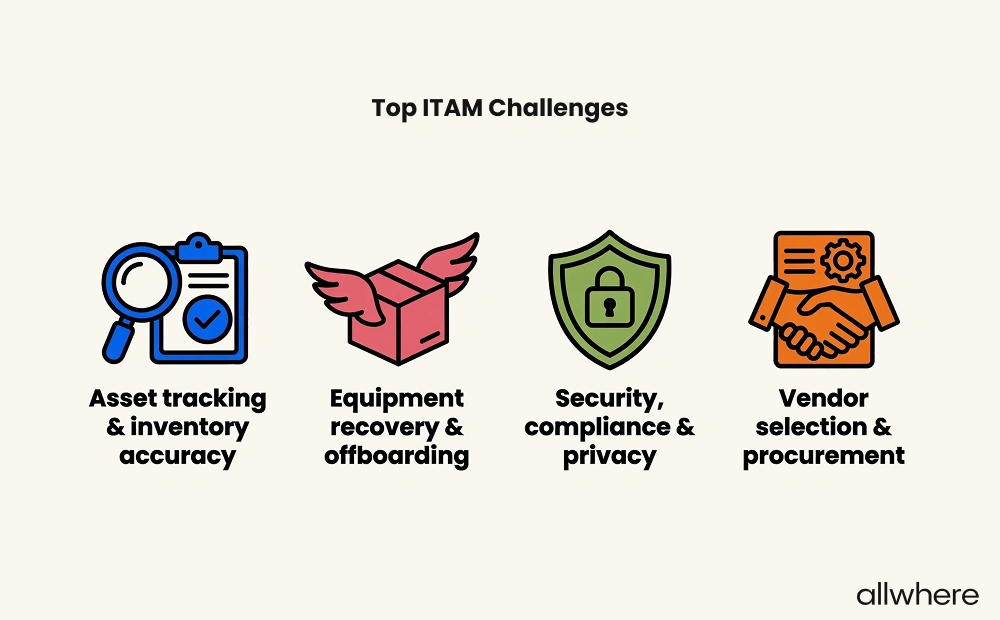
In our article on IT asset management best practices, we comprehensively covered today’s top ITAM challenges from our own unique research.
While survey respondents identified 100 different challenges, two of the biggest were asset tracking and inventory accuracy, indicating that asset visibility is a major issue among many organizations.
To quantify, only 80% of respondents were “very confident” they knew where all of their assets were at any time, and the remaining 20% were only “somewhat confident” about managing assets.
This data shows that blind spots are the norm, and many companies could benefit from investing in IT asset management services or software.
With allwhere, for example, you can sync and track your entire asset inventory from a single dashboard so that you have a complete overview of everything you have throughout the asset lifecycle.
That way, you always know what you have on hand, as well as what’s sitting in storage.
From procurement to deployment to management to retrieval, you always know what’s going on, and there aren’t any blind spots for effective risk management.
Security Threats from Unmanaged Assets
Whenever your company uses IT assets, this inherently comes with a level of vulnerability, and potential threats can always arise.
If sensitive information from asset data winds up in the wrong hands, it can potentially be exploited. And as you may already know, data breaches are an all-too-common occurrence.
For perspective, research from the Identity Theft Resource Center found that “in the first half of 2026, there were 1,803 reported data compromises, compared with 1,732 during the same time last year.”
And the security risk increases even more when companies have a large number of unmanaged devices during inventory management.
When asked, “Do you ever use a personal device for work tasks?”, 81% of remote employees reported using a personal device for work in our remote work survey.
Of those workers, 7% use it always, 28% use it often, and 46% use it sometimes.

What’s really concerning is that 15% have regularly accessed company data on an unsecured device — something that’s a huge problem for risk management because it can easily open the door for a cyber threat.
Another mistake that some companies make is using physical assets like laptops for too long. Not only can this result in decreased performance and lower productivity, but aging hardware also becomes a security risk because it may not support current security features.
To quantify, our laptop age research found that roughly the five-year mark is when aging hardware officially becomes a security risk.
Note that replacing a laptop after three years is generally considered ideal, but five years is the max before it creates an operational risk in the asset management process.
Compliance and Regulatory Risk
Because of the amount of asset information that many companies handle through their IT network, this often comes with a level of compliance and regulatory risk that’s baked into operations.
For example, major data regulations like the GDPR and PCI-DSS are in place to ensure strict accountability for companies that have access to highly sensitive personal information and banking data.
While the specifics can vary from industry to industry, you must protect any sensitive data throughout the entire asset lifecycle, both with software and hardware asset management.
This typically starts with maintaining detailed asset records and having clear accountability standards in place through something like documenting the chain of custody.
It’s also crucial that when decommissioning devices, sensitive data is properly disposed of or safely transferred before devices change hands to ensure proper asset management.
Equipment Recovery and Offboarding Risk
Among the top ITAM challenges for companies in 2026, equipment recovery and offboarding was cited as the second-biggest in their asset management practices.

There are two main issues they encounter during this stage of the asset management lifecycle.
One is losing assets during shipping. 64% of companies said they have lost an IT asset either while shipping it to a remote employee or when an employee ships it back during retrieval.
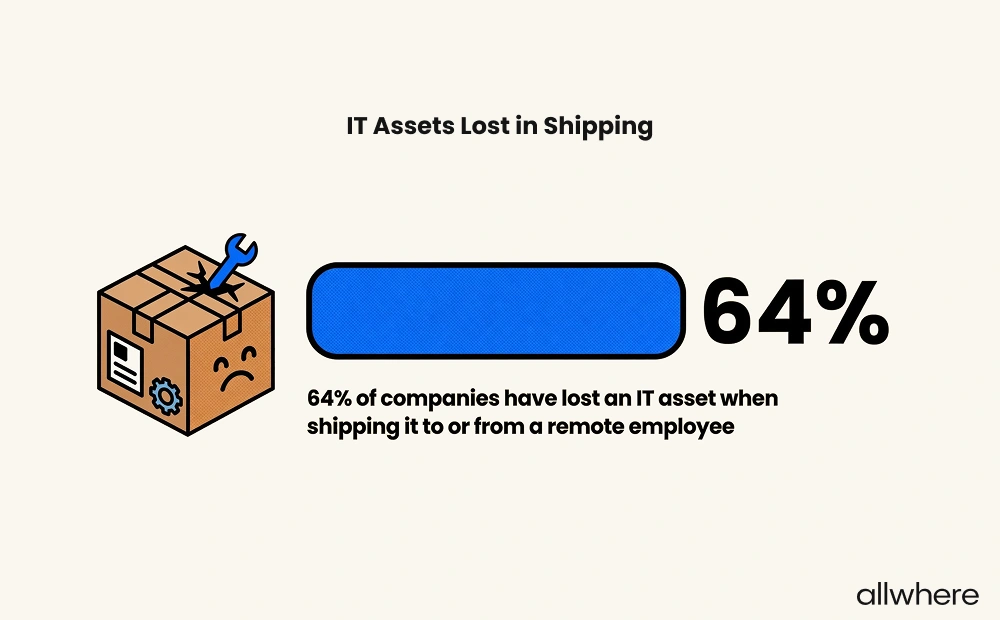
When this happens, it typically takes one to two weeks to recover a lost asset, which can create unnecessary friction and disrupt other areas of operations.
The other common issue is when employees never return their former employer’s equipment. And this is something that happens more often than you may think.
Data from our remote work statistics survey found that “24% of remote workers never returned employer-provided equipment.”
“On top of that, when leaving a remote job, 21% of employees said they were never even asked to return their equipment, while 10% said they were asked but never did.”
This shows the importance of having a formal retrieval device process in place and a strategy for what you’ll do when remote employees refuse to return equipment.
Here are some examples of how modern companies approach this aspect of asset risk management.

Vendor and Procurement Risk
In the number four slot for the top asset management challenges is vendor selection and procurement. The main issues here are vetting vendor legitimacy and value.
With so much competition and the potential for counterfeit/low-quality inventory, it’s not always easy to decide who’s the right fit for your organization.
And if you make the wrong call when purchasing critical assets, it can create a negative domino effect, where everything from asset performance and employee productivity to security and operational efficiency is impacted.
Besides this, vendor dependence can be problematic. If, for example, you put all of your eggs in one basket, you may run into issues like inventory shortages, shipping delays, and inflated costs, all of which can be highly disruptive and reduce your cost savings.
That’s why many organizations choose to partner with a third-party expert like allwhere who can handle the entire asset lifecycle while leveraging a vast vendor network to procure quality assets for a reasonable price.
Operational and Productivity Risk
Another major area of concern is poor asset provisioning, which shows up at onboarding.
A good example of this is when new hires aren’t provided the proper equipment to successfully do their jobs on their first day.
Data from our employee onboarding statistics survey found that “31.5% of new hires were missing equipment on day one, and only 45% had accounts/software/access that was fully ready.”
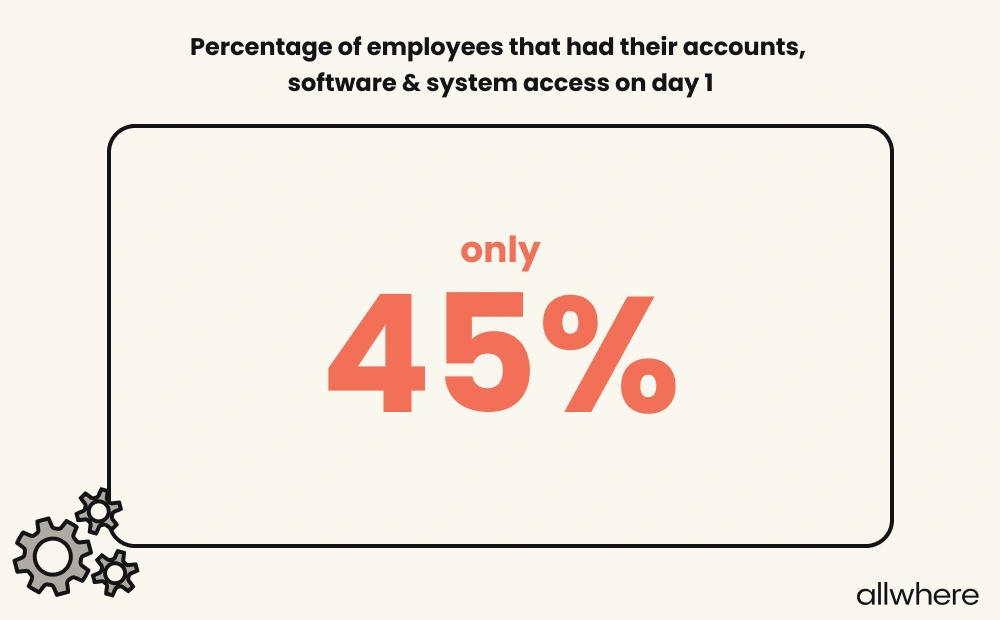
In this scenario, employees are handicapped in the tasks they can perform, which can greatly reduce their productivity and get them started out on the wrong foot.
And here’s what’s interesting. A poor onboarding experience makes employees 2.5x more likely to quit — something that can be disastrous to your retention rate.

But on the other hand, equipment-ready hires that can instantly jump into full asset utilization are 4.3x more likely to rate their onboarding experience as “excellent.”

Even though ensuring employees have all of the right equipment and accounts/software/system access on day one may not seem like that big of a deal, the data clearly shows that it can have a huge impact on the employee experience, retention, and your company’s overall bottom line.
How to Mitigate IT Asset Management Risks
Now that we know what the biggest asset risks are, what can you do to optimize your risk management strategy?
Start with a formal risk assessment to identify your current state of risk management and the specific areas that need your attention. Go for the low-hanging fruit first and gradually work your way through until your risk management is acceptable. Then continually refine.
Also, invest in asset management solutions like asset management software or services to help manage your workflows end-to-end.
This creates clear ownership, asset discovery, asset visibility, and automated asset tracking, which is exactly what you need for baseline risk mitigation.
Note that 93% of IT teams already use formal ITAM software versus 7% that simply use spreadsheets for risk management.
Here are some specific features that ITAM solutions provide that can help you address asset management challenges head-on.
- Centralized inventory - You can create a fully fleshed out inventory of all of your assets and automatically sync new devices and remove old devices for a complete, up-to-date. overview.
- Asset tracking - ITAM risk management software lets you know which employee has a device and where it’s located so there’s never any guesswork. And whenever an asset is in transit, whether you’re shipping it to an employee or retrieving it, you’ll know exactly where it’s at.
- Lifecycle management - Keep tabs on all of your IT assets as they move from procurement to deployment to storage to retrieval. Also, know what condition they’re in, when maintenance needs to be performed, when updates need to be made, asset criticality, and more.
- Enhance security - By ensuring maintenance and security updates are performed on time, along with managing security controls, you can significantly enhance security.
Complete Asset Lifecycle Management with allwhere
If you’re looking for a one-stop shop for asset risk management, you’ll want to know about allwhere.
allwhere has been rated as one of the best IT asset management companies and can help you automate the entire device lifecycle.
We specialize in procurement, deployment, management, storage, and retrieval. We offer full asset visibility via a single user dashboard, as well as real-time tracking so you’re never in the dark.
